A practical guide to getting dressed for staying in
A Guide to Soft, Comfortable Loungewear Layers
The right layer does not announce itself. It settles over a T-shirt, warms the shoulders when the room turns cool, and stays comfortable through the small migrations of a day at home—from desk to kitchen, sofa to open window. Choosing one means looking beyond softness alone to consider breathability, drape, warmth, construction, and the ordinary care that lets a garment remain a pleasure to wear.
Comfort is a collection of small decisions
There is a particular kind of indecision that belongs to a home at the edge of a season. The heating has not quite earned its keep; the sun, though present, is mostly decorative. One reaches for a layer, then takes it off, then puts it back on after an hour. The successful loungewear piece makes fewer demands. It provides enough warmth to soften the room’s chill without turning a quiet afternoon into a negotiation with one’s own temperature.
That sounds simple, but comfort is not a single sensation. A garment can feel pleasant when first pulled on and become too warm after a few minutes. It can be soft to the touch but cling in a way that makes movement feel restricted. It can look relaxed on a hanger yet pull across the shoulders when worn over another layer. Fabric, shape, weight, and finishing all contribute to whether a cardigan or sweater becomes a dependable companion or an object one keeps draped over a chair.
It helps to think of a soft lounge layer as a modest piece of equipment. Its job is not merely to look cozy. It should accommodate the rhythms of the day: sitting, stretching, reaching for a mug, stepping briefly outdoors, returning to a warm room. The best choice is therefore personal, but a few practical questions—about fiber, fit, climate, and care—can make the search more deliberate.
Begin with the feeling you actually want
“Soft” is an appealing word, but it describes more than one kind of experience. Some people want a smooth, cool surface against the skin. Others prefer a brushed, slightly fuzzy hand that feels immediately warm. A loosely knitted fabric may feel gentle and yielding, while a denser knit can offer a steadier, more substantial sensation. None is automatically better. The useful question is whether the fabric feels comfortable for the length of time and in the circumstances in which you expect to wear it.
If you are sensitive to scratchiness, test a garment at the neck, wrists, and inside of the elbows, where a seam or fiber can become noticeable. A quick touch in a shop may not reveal how a knit behaves after an hour. When shopping online, study the fiber description and construction notes, and look for specifics rather than relying on broad assurances of luxury or softness. Fiber content is not a perfect forecast of feel, but it is a helpful beginning.
Personal preference also changes with the layer beneath. A cardigan worn over a cotton sleep shirt may feel different from the same piece worn over a textured blouse. If you plan to wear it directly against your skin, prioritize a handfeel you already know you enjoy. If it will usually sit over a base layer, you may have more room to choose a textured knit or a slightly more structured yarn.
What fibers bring to a lounge layer
Natural fibers and blends each have their own character. Wool is valued for warmth and can help buffer changes in temperature, though different wool yarns vary widely in softness and texture. Alpaca is often chosen for a soft, warm feel and can provide substantial insulation without a heavy, bulky appearance. Cotton tends to feel breathable and familiar, making it a useful choice for moderate warmth or for people who prefer a smoother, less insulating layer. Silk, when blended with another fiber, can contribute a smooth hand and a fluid quality to the fabric.
Blends are not a compromise by definition. A well-considered blend can balance characteristics that a single fiber may not provide on its own: warmth with drape, resilience with softness, or a lighter feel with enough insulation for a cool room. The proportions matter, as do the yarn, knit structure, and finish. A label gives you the ingredients; the garment’s shape and fabric tell you how those ingredients have been put to work.
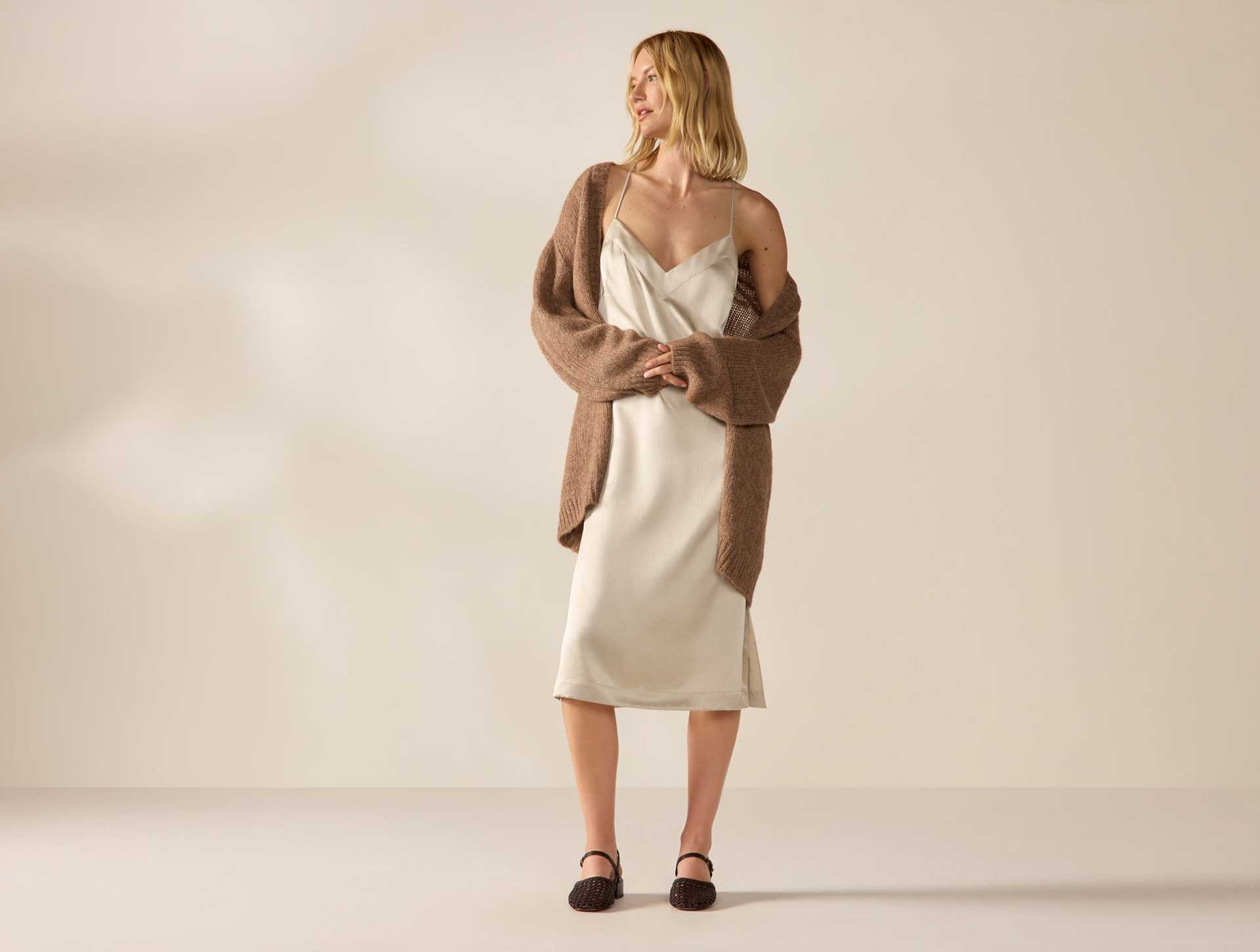
For example, the Sibayo Cardigan combines 80 percent alpaca with 20 percent silk in a relaxed, open-front design. Its long balloon sleeves and ribbed placket, cuffs, and hem give the silhouette definition without making it feel buttoned-up. The blend and open shape are worth considering if you want a layer that offers warmth while remaining easy to wear over sleepwear or everyday essentials. As with any garment, whether it suits you will depend on the feel you prefer, the temperature of your home, and how you intend to use it.
Care requirements deserve attention at the same time as fiber content. Some knits are designed for routine washing; others call for more delicate handling or professional cleaning. A beautiful garment that is inconvenient to maintain may spend more time folded away than on your shoulders. Before deciding, imagine the whole life of the piece: how often you will wear it, how it will be cleaned, and whether its care fits the way you actually live.
Warmth without the burden of bulk
A lounge layer should make sense in its setting. In a warm apartment, a dense, heavy sweater may quickly become too much. In a drafty room, a fine open knit might be attractive but insufficient on its own. Consider the temperature you usually keep indoors, whether you tend to feel cold, and whether the garment will be worn over one layer or several. These ordinary details are more useful than the season printed on a product page.
Weight and warmth are related, but they are not interchangeable. A lightweight fiber with good insulating properties can feel warm without making the wearer feel wrapped in upholstery. A more open knit may let air circulate and work well as a transitional layer, though it will generally offer less protection against a cold draft. A denser construction can hold warmth more effectively, but may feel less airy during long periods of wear.
Look at the garment’s silhouette, too. A cardigan that hangs open allows quick adjustments as the room changes. A high neckline or close-fitting front can preserve more warmth. Ribbed cuffs and hems help a piece hold its shape and can reduce unwanted looseness at the edges. Sleeves matter more than they sometimes get credit for: a sleeve that rides up every time you reach forward becomes a persistent small annoyance, while a very voluminous one may gather around the hands when you work or eat.
Breathability and the temperature of the day
Breathability is not only a warm-weather concern. At home, a person may spend the morning at a desk, carry a basket of laundry upstairs, and settle down again without changing clothes. A layer that traps too much heat can feel uncomfortable during these modest shifts in activity. A more breathable fabric helps the wearer feel less sealed in, especially when paired with a base layer that is comfortable against the skin.
Construction plays a part. A loose, open knit generally allows more air to pass through than a tightly compact fabric, while a close-fitting garment may retain warmth simply because it leaves less space for air movement. The weave or knit is not a technical footnote; it is one of the reasons two garments made from similar fibers can feel quite different. When product descriptions mention an open front, relaxed fit, or lightweight construction, those details may indicate how a layer will sit and move—not a guarantee of a particular temperature experience.
Layering gives you a way to respond. A thin, comfortable base can be enough indoors; a cardigan adds warmth when needed and can come off without ceremony. This is often more practical than choosing one heavy garment expected to serve every mood and temperature. The goal is not to dress for an imaginary perfect day, but to have a combination that adapts to the real one.
Drape, fit, and freedom of movement
Fit can be difficult to judge from a photograph, especially when a garment is described as relaxed. Consider where the shoulders fall, how much room there is through the body, and whether the sleeves allow comfortable movement. A loungewear layer need not be oversized to feel at ease. A little space can make it easier to wear over another garment, but too much fabric may twist, catch, or become inconvenient when you are doing ordinary things around the house.
Drape is the way the fabric falls when worn. A soft, fluid knit may follow the body gently, while a firmer yarn can hold a more distinct shape. Neither quality is inherently more comfortable. If you want a piece that feels unobtrusive, pay attention to how it hangs when open and whether the front edges remain manageable as you move. A relaxed cardigan with ribbed finishing, for instance, may combine a loose body with more defined edges.
Think about the clothes underneath. A layer intended for sleepwear may need a different fit from one worn over a button-front shirt or a thick T-shirt. If you expect to wear it across a range of outfits, leave enough room for the bulkiest combination you realistically plan to use, not the bulkiest one imaginable. A garment that works with your routine is more valuable than one that fits a hypothetical wardrobe.
Construction is part of comfort
When a layer feels good, it is tempting to credit the yarn and stop there. But seams, cuffs, hems, and front finishes determine how the yarn behaves. Ribbing can help edges recover their shape. A well-finished placket can lie neatly rather than curl or flap. A sleeve seam placed where it does not press into the arm can make a difference over a long afternoon. These details are quiet, which is precisely why they matter: they either disappear during wear or repeatedly call attention to themselves.
Check that the garment’s weight is distributed comfortably. Heavy sleeves can pull on the shoulders; a long cardigan may feel different when open than when fastened. If you are shopping in person, put the garment on and sit down, lift your arms, and reach forward. If you are shopping online, review the measurements and compare them with a similar piece you already enjoy. Measurements do not capture every aspect of fit, but they offer a more reliable starting point than assuming your usual size will behave the same way in every brand.
Durability belongs in the comfort conversation. A knit that pills rapidly, stretches out, or becomes difficult to care for may lose the qualities that made it appealing. No garment is immune to wear, and natural fibers can require particular attention, but sound construction and habits suited to the care label can help preserve shape and feel.
A kinder routine for knitted garments
Care begins before the first wash. Read the label and follow the garment’s stated instructions rather than relying on a general rule for all sweaters. Fiber blends and finishes differ, and a method suitable for one knit may be unsuitable for another. If the label recommends a particular cleaning method, treat that guidance as part of the garment’s design.
Between cleanings, airing a garment can sometimes be enough to refresh it, depending on how it was worn and the care guidance provided. When washing is appropriate, avoid treating a knit as though it were a sturdy towel. Gentle handling helps limit stretching and friction. If the instructions call for hand washing, support the garment’s weight as you lift it; a wet knit can become heavier and more vulnerable to distortion. For machine-washable pieces, use the settings and precautions specified on the label.
Drying is equally important. A garment that is meant to dry flat should not be hung while wet, since gravity can pull it out of shape. Smooth it into its intended dimensions and let it dry according to the care instructions. Store knits folded when hanging could stretch the shoulders. Small habits like these are less glamorous than choosing a color, but they help keep a favorite layer in circulation.
For routine upkeep, address snags and loose threads carefully rather than pulling at them. Pilling can occur where fabric rubs against itself or another surface; handle it gently and use a method appropriate to the material. The point is not to preserve a garment in a state of untouched perfection. It is to keep it comfortable, useful, and presentable through ordinary wear.
Choosing a layer that earns its place
Before buying, try answering a few questions plainly. Will you wear it over bare skin, sleepwear, or daytime clothes? Do you want a light layer for changing temperatures, or something that feels like a proper sweater? Are you drawn to a smooth surface, a soft halo of texture, or a crisp knit? And will you be content with the care it requires?
- For flexible indoor layering: Consider an open front and a fit that accommodates the base layers you already wear.
- For warmth without excessive weight: Compare fiber blend, knit structure, and garment weight instead of judging warmth by thickness alone.
- For sensitive skin: Pay attention to the areas where the garment touches directly, and favor familiar fibers and finishes.
- For everyday use: Make sure the care instructions are realistic for your household routine.
- For lasting comfort: Check sleeve length, shoulder fit, edge finishing, and how the garment moves when you sit and reach.
There is no universal ideal. One person’s perfect lounge cardigan is another’s too-warm extra layer; one wearer loves the enveloping feeling of a loose silhouette, while another prefers a tidy shape that stays out of the way. The right choice is the one that supports your habits rather than asking you to develop new ones around it.
The ease of a useful extra layer
A good loungewear layer has a small but meaningful place in the domestic landscape. It is close at hand on a cool morning, useful during a long stretch of reading, and easy to wear when the temperature shifts without warning. Its success may be measured less by how often it is admired than by how often it is reached for without thought.
Softness helps, but it cannot do the whole job. Comfort also comes from air moving through the fabric, a shape that permits movement, a warmth level suited to the room, and care requirements that do not make ordinary wear feel like a special occasion. Look closely at those qualities, and a cardigan or sweater can become more than an attractive object: it can be a dependable layer, ready for the unremarkable hours in which much of life takes place.