Knitting & Textiles
How Stitch Texture Shapes the Look and Drape of Knit Throws
A knit throw is more than a field of yarn laid across a sofa. Its stitches give it character: a surface to notice, a weight to feel, and a particular way of folding, pooling, or holding its shape. Understanding that small architecture can make choosing one less like guessing from a picture and more like knowing what you want a room to feel like.
A throw tends to enter a room modestly. It is folded over an arm, left at the foot of a bed, or gathered into a promising heap beside the book someone means to finish. But its apparent casualness conceals a series of decisions. What is the yarn? How tightly is it knit? Does the surface rise in little knots, run in parallel ridges, or open into a loose mesh? These are not merely decorative questions. They determine how a textile feels in the hand and behaves in daily use.
Stitch texture is one of the most immediate clues. It can make a cotton throw look substantial without making it heavy, give a simple neutral color a lively surface, or allow a fabric to fall in soft folds rather than sit in a crisp rectangle. A photograph may suggest the answer, but the useful details are often in the construction notes: seed stitch, ribbing, openwork, a links-knit edge, or a high-low pattern. Each term points toward a different balance of structure, stretch, air, and visual emphasis.
The distinction matters especially with cotton. Cotton is familiar, breathable, and often straightforward to care for, but it does not behave exactly like wool. It tends to have less springy recovery: when a knitted cotton fabric is stretched or pulled out of shape, it may not bounce back with the same ease as an elastic animal fiber. The stitch pattern, therefore, is not just ornament. It helps determine how the throw gives under its own weight, how it lies on furniture, and how well it keeps its proportions after use and laundering.
The fabric beneath the pattern
A knit is made from loops. In a simple knitted fabric, those loops form columns and rows, and their arrangement controls much of the textile’s character. A compact stitch produces a denser surface; a looser one makes room for air and movement. Some patterns alternate knit and purl stitches to build texture into the fabric. Others shift between open and closed areas, creating a surface that is patterned by light as much as by yarn.
The same stitch can look different depending on the yarn and the scale of the knitting. A fine cotton yarn in a small seed stitch may produce a restrained, pebble-like surface. A thicker yarn in a larger version can make those small bumps feel almost sculptural. Likewise, a ribbed pattern worked closely may look tidy and architectural, while a relaxed rib can seem more casual and forgiving. Stitch names are useful shorthand, but they are not a complete description of the finished fabric.
This is why it helps to consider texture alongside fiber, weight, and care. A throw’s performance is not dictated by one feature. Fiber tells you something about softness, breathability, and maintenance. Stitch tells you how the yarn is organized. The dimensions and finishing tell you whether the fabric has room to drape or is held more firmly at its edges. Together, these details offer a better picture than any single adjective, especially the word “cozy,” which has been asked to do a remarkable amount of work in home textiles.
Seed stitch: a textured surface with quiet structure
Seed stitch is formed by alternating knit and purl stitches, with the arrangement reversed on the following row. The result is a field of small raised bumps. It is textured without being ornate, and its surface tends to look similarly lively from different angles. In a throw, that even, granular character gives a plain color more depth. A cream textile can seem less blank; a darker shade can reveal subtle shifts in light without relying on a conspicuous pattern.
The small relief of seed stitch can also make the fabric appear more substantial than a smooth knit. That impression should not be confused with sheer weight: a textured surface may look rich while remaining comfortable to handle. But seed stitch does not, by itself, guarantee a particular drape. The yarn thickness, knitting tension, and overall construction matter. A dense seed stitch may lie with a composed, slightly weightier presence; a more open one may fall more softly.
For a room, seed stitch is a useful middle ground. It contributes detail without competing with a patterned rug, a checked cushion, or a crowded bookshelf. On a sofa, the texture is visible from across the room but still rewards a closer look. On a bed, it can add dimension to a plain duvet or folded layer. In either setting, it makes the throw feel designed without insisting that everyone notice the design.
Ribbing: movement, elasticity, and direction
Ribbing alternates columns of knit and purl stitches, producing ridges that run in parallel lines. Because those columns can draw together and expand, ribbed fabric often has more give than a plain, stable knit. That flexibility can make an edge easier to handle and lend the surface a pleasing rhythm. In clothing, ribbing frequently appears at cuffs and hems, where stretch is useful. In a throw, it can serve as an overall texture or as a detail that defines the border.
Ribbing also creates visual direction. Vertical ridges can make a fabric seem elongated; a broad rib can read as bold and graphic, while a fine rib is more understated. The texture catches light along its raised lines and allows shadow to settle in the channels between them. The effect is not unlike a very quiet corduroy, though the knit remains softer and more responsive.
That responsiveness has a practical side. A throw with ribbed sections may stretch when pulled across a lap or tugged from a chair. Cotton knit can gradually change shape with use, particularly if it is frequently stretched or allowed to hang under its own weight. Careful handling and the manufacturer’s washing guidance help, but a buyer should not assume that a knitted textile will remain as rigidly rectangular as a woven blanket. Flexibility is part of its appeal; it is also part of its behavior.
Openwork: an airy pattern with visible space
Openwork stitches create deliberate gaps in the knit. The openings may be small and repeated, or arranged into a more conspicuous lace-like design. Either way, the fabric has a lighter visual presence. It lets air pass through more freely and gives the surface a sense of delicacy, even when the yarn itself is not especially fine. On a bed or sofa, openwork can make a throw feel more like a decorative layer than a heavy barrier against the weather.
The openness changes how the textile drapes. Gaps reduce the amount of yarn in some areas, so the fabric may feel lighter and move readily. Depending on the stitch and finishing, it may also be more susceptible to stretching or catching. This is not an argument against openwork; it is a reminder that the beauty of a loose construction comes with ordinary considerations. A throw meant for constant, rough use may call for a denser knit. One used for gentle layering can take advantage of the airiness.
Open stitches also make color and light part of the pattern. Against a dark sofa, the holes become more visible; against a pale duvet, they may recede. The underlying surface can show through, giving the same throw a different impression depending on where it is placed. This makes openwork particularly adaptable for rooms that need a little texture but already have enough visual activity. Rather than adding another solid block of color, it adds a delicate overlay.
High-low texture and the question of drape
A high-low knit changes the height or prominence of stitches across the surface. The pattern may create raised and recessed areas, adding a more sculptural quality than a uniformly flat fabric. Paired with ribbed seed stitch, it can offer both small-scale texture and a larger change in surface. The effect is subtle from a distance and more apparent up close, which is often a useful quality in a textile intended to live quietly in a room.
Drape is the word used to describe how fabric falls. A soft drape means the throw bends and gathers easily; a firmer drape suggests that it holds a more defined shape. Neither is inherently better. A fluid throw may settle attractively over the corner of a sofa and feel easy to wrap around the shoulders. A more structured one can look orderly when folded at the foot of a bed and may stay in place rather than slipping into a heap.
Stitch pattern influences drape by changing the fabric’s density and flexibility, but it works in concert with yarn and weight. A heavy, dense knit may hang more dramatically simply because gravity has more material to act upon. A lighter openwork construction may float and fold with less force. A ribbed fabric may stretch in one direction more than another. When evaluating knit throws, it is useful to ask not only whether the surface looks soft, but what you want it to do: cover, fold, trail, or gather.
Cotton, comfort, and care
Cotton is valued for its breathable, familiar feel and its suitability for layering across much of the year. Organic cotton throws can offer a soft hand and a relaxed finish, though the words “organic” and “cotton” do not tell you how a particular knit will behave. Construction still matters. A tight stitch may feel smoother and more compact; a textured one may feel more dimensional; an open one may feel airy. These differences are worth noticing before choosing a throw for daily use.
Care instructions belong in the same conversation. A gentle cold wash and low tumble-dry setting, where specified, can be convenient, but knitted fabrics deserve a little attention. Follow the item’s actual instructions rather than general advice borrowed from another garment. Remove a throw promptly after drying when directed, and avoid pulling it into shape while wet unless the care guidance recommends that approach. If the knit stretches over time, laying it neatly rather than hanging it for storage can help limit unnecessary strain.
Edges matter, too. A finished hem or knit border can help a throw look composed and protect its perimeter from the impression of being unfinished. A links-knit hem, for example, contributes a distinct edge detail. But a handsome border cannot cancel out the basic tendencies of the fabric. The center and edge may have different textures, and a knitted throw may still give with use. The practical question is whether that relaxed character suits the way it will be used.
Reading a product description with a knitter’s eye
Product descriptions often compress a great deal into a few construction terms. “Ribbed seed stitch” indicates more than a general impression of coziness: it suggests a textured surface with repeating knit-and-purl structure. “High-low knit pattern” signals variation in the surface. “Links knit hem” points to a particular finish at the edge. Taken together, those phrases imply a throw that has more visual dimension than a plain jersey-like knit, while retaining the flexible character of knitted cotton.
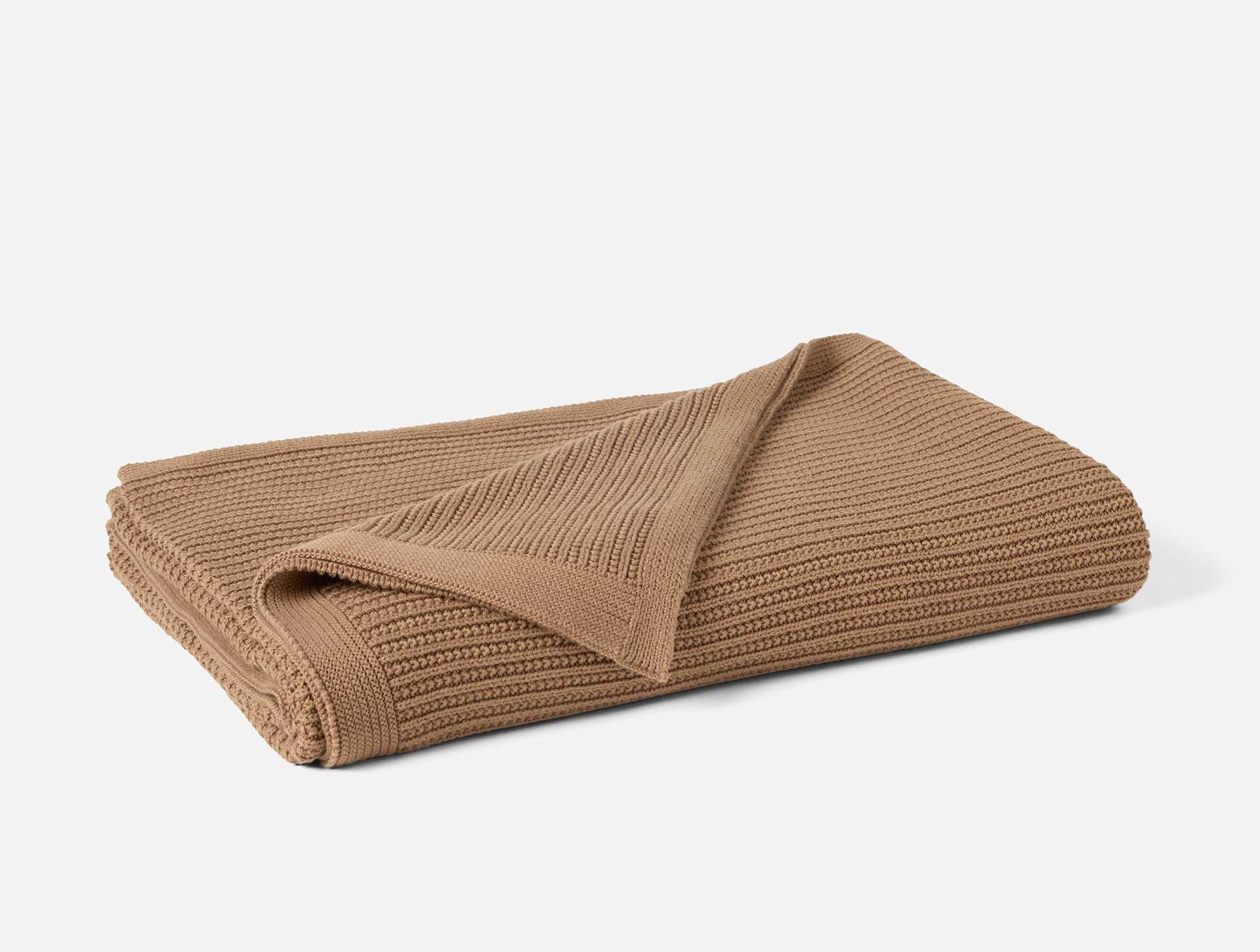
The Linea Organic Knit Throw by Coyuchi offers a concrete example. It is made from 100% organic cotton and combines ribbed seed stitch with a high-low knit pattern. The links-knit hem and varied texture give the surface definition, while the cotton construction is described as soft and breathable. Its listed care is a cold wash on a gentle cycle with like colors, followed by low tumble drying and prompt removal; the product information also notes that the knit may stretch and that its size or shape can change over time.
That final note is especially useful. It sets a realistic expectation: this is a knitted textile, not a rigid panel. Its textured construction is part of its appeal, and some change in shape may accompany regular use. For someone choosing a throw to drape over a sofa or layer at the foot of a bed, that relaxed quality may be exactly right. For someone seeking a sharply tailored rectangle that never shifts, the note is worth taking seriously.
Matching texture to a room
The easiest way to choose a stitch is to start with the room rather than the pattern name. A smooth, minimally textured space may benefit from seed stitch or a high-low surface, which introduces depth without adding a busy motif. A room already full of pattern may be better served by a quiet rib or a simple openwork knit that adds texture without another strong visual rhythm. Color matters, but texture can do much of the work when the palette is restrained.
Consider where the throw will sit. On a narrow chair, a supple knit may be easier to fold and tuck. Across a broad sofa, a more substantial texture can keep the textile visible rather than letting it disappear into the upholstery. At the foot of a bed, an even, composed surface may look deliberate when folded; an airy knit can make the arrangement feel lighter. These are not strict rules. A throw is often moved, borrowed, and left wherever the evening ends. Still, thinking about its usual place can clarify what kind of drape would be welcome.
If possible, examine the knit closely. Look at the scale of the stitches, the spacing between them, and whether the surface is consistent. Notice how the edge is finished and whether the fabric seems likely to stretch in one direction. If you are shopping from a description, use the construction details as evidence rather than relying on broad claims about softness. Fiber content, stitch pattern, dimensions, and care instructions together form a more dependable portrait.
A small architecture for everyday comfort
The appeal of a knit throw lies partly in its modest usefulness. It warms a lap, softens a room, and gives an otherwise bare chair something to do. Its stitches are easy to overlook until they determine whether the fabric feels springy, weighty, or airy; whether it lies in clean folds or wanders across a cushion. Then the pattern becomes less an embellishment than a kind of quiet engineering.
Seed stitch offers a pebbled surface and gentle structure. Ribbing lends direction and stretch. Openwork allows light and air to enter the composition. High-low patterns create dimension, while the yarn and finishing shape the final balance. For cotton throws, these distinctions can help you anticipate not only how a textile looks but how it will behave through ordinary handling and care.
The best choice is not necessarily the most intricate stitch or the softest-sounding description. It is the one whose texture suits the intended role: a breathable layer for a bed, a pliant companion on a sofa, or a tactile accent that gives a room a little more depth. Once you know what the stitches are doing, a knit throw becomes easier to read. And, perhaps, easier to imagine in the place where it will eventually be left.